Turning? There was never enough fraud to justify any effort, less you consider gerrymandering and unfair polling practices, or other efforts to limit voting rights or fair outcomes.
That’s election fraud.
Nah that’s the system working as designed.
It’s just designed in a shitty way, and instead of doing something productive like, oh, I dunno, fucking governing…the Republicans have been chipping away at rights in a very strategic and legal way, in order to see the final payout of the Southern Strategy: Unitary Executive Theory (or, in non-legal speak, dictatorship).
This all seems very familiar. Perhaps this isn’t the first time someone cemented their power legally, by changing the laws to their suiting?
It’s just designed in a shitty way
No, it really isn’t. Aside from the whole first-past-the-post thing, the process of physically voting itself was close to perfect and worked well. What happened to it was unaccountable electronic voting machines in private hands, a lot of quiet power grabs, and open, blatant illegal acts by officials entrusted with making sure all who can vote can do so and keeping our votes safe.
Don’t blame a voting system – or a Constitution – when the REAL problem is corruption.
The electoral college is shitty by design.
The electoral systems we have are reasonably decent - with the glaring caveat that we desperately fucking need RCV or some variant thereof to break the back of the two-party system.
“IS” illegal.
Always has been.
The main thing they seem to be doing that’s officially illegal is that they are taking their own databases of dubious quality, and then manually inputting that information into state voter registration verification sites. These sites by and large make the user legally certify they either are the voter or have their express authorization (e.g. “Hey, bud, will check my voter registration for me?”). They’re basically asking the entire staff to engage in a bit of light identity theft 40 times a day.

Voter suppression is what it is, targeted at liberal areas. Closing polling places, trying to disqualify women because of their married names, screwing with the USPS. It’s all suppression.
When dealing with MAGA always remember every baseless accusation is a confession. When they cry election fraud, they are plotting or doing election fraud.
Gaslight. Obstruct. Project. The bread and butter of the Greedy Oligarchal Pedophile-protectors.
Fucking everything that pedo does is illegal child killing filth.
Wait, it’s not legal to bribe voters with 5000 USD so you can keep your corrupt friends in power to protect your treacherous and corrupt old shitty ass from prison?
Next, you’re gonna tell me that The “United” States of America aren’t the lamest & angriest mofos on Earth?
Good news (I guess): Trump is not going to break that particular law re: the $5000 that we’ll hear nothing more about after the election.
The promise itself is already illegal.
That means absolutely nothing for this administration.
IDGAF what it thinks; objective reality exists.
IDFAF
“I don’t… fuck a fuck”? :)
And the objective reality is that the current admin suffers no consequences for violating the law, and very likely never will.
Something being illegal only matters if the law is enforced. That’s the objective reality.
I mean, it’s illegal to own more than 6 sex toys in Texas, but it’s not something that’s enforced so it’s functionally not illegal.
It should mean something to everyone else.
I never understood the practice of registering to vote. Why that extra step? Are not every US citizens registered? Why not just sending everyone of these the ballots?
This is working in other countries, why not in the US?
Your vote is tied directly to where you live here, all political offices cover some territory (a state, city, district, village, town, etc). So your vote is directly tied to where you live.
But it’s not necessarily the case that the state always knows where someone lives. Yes, there are property deeds and utility bills and what-not, but there is no official place where everyone’s addresses are held.
Therefore, “Registering to Vote” is really more like registering your address, so they know which ballot you need to vote on. Even ex-pats what no longer live in the country (but are still citizens) get to vote at the last US address they lived at.
There isn’t always an “unregistration” process either. When you move, you just re-register. Since most of these are administered at the State level, if you move between States you may end up registered in two places. In most cases, that is perfectly legal! You only break the law if you actually vote in the same election in more than one place.
One of the major parties wants less citizens to vote, because they do better if less people vote, especially “those people”. The other of the major parties wants all citizens to be able to vote. So setting up an automatic voter registration in all states, since this IS a given state’s right, is a bit of a conflict, oddly enough. I absolutely agree it would in fact save a lot of trouble to just register every US citizen at age 18.
elections in the US are run by the states, not the federal government. a handful of states (specifically California, Colorado, Hawaii, Nevada, Oregon, Vermont, and Washington) automatically register eligible voters and send a mail ballot to every registered voter
Yeah I understand what they are doing, but not WHY. (Other than thinning out voters)
but not WHY. (Other than thinning out voters)
congratulations, you actually do understand why
The measures target people who are likely to vote Democrat much more than those likely to vote Republican. It is suppresion of Democrat voting.
We register to vote in other countries too, it’s just an automatic process that happens alongside other things like filing your taxes.
There is a big difference being registered automatically or by self registering.
Quick! Someone call Alvin Bragg! Only a human who has ever actually press charges against this asshole can protect us.
Can private citizens who feel they can prove they’ve been directly harmed by presidential acts, sue the president?
Maybe a class-action per unconstitutional deed?
Can we get a GoFundMe for this or something?
Can private citizens who feel they can prove they’ve been directly harmed by presidential acts, sue the president?
It’s an interesting argument to debate, and has been since the beginning. What’s really telling is how much Trump is mentioned in that wiki vs. the past Presidents. Almost as if he’s seeing how far he can push the envelope.
There’s a theory that he’s playing 11-D chess and strategically testing the system through clever probs and prods.
There’s another theory that he’s always just done whatever he felt like, damn the consequences. And since there isn’t any material opposition to a billionaire in a plutocracy like the US, nobody stops him now any more than anyone has ever stopped him before now.
What’s really telling is how much Trump is mentioned in that wiki vs. the past Presidents.
I’d say Nixon was the real historical test case, at least from the perspective of the article. The Trump Election Obstruction case is more interesting because it’s an edge case, even within very expansive immunity provisions. It was specifically with respect to Nixon v. Fitzgerald, which had ostensibly defined the boundaries of Presidential immunity… until it didn’t.
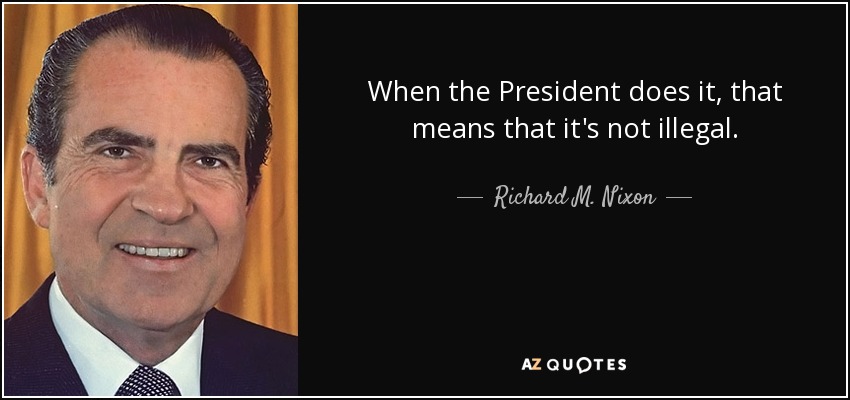
“I am not a crook”