

A robot was on fire. Again. It was the summer of 2024, and the cutting-edge robots inside General Dynamics’ sweltering artillery factory near Dallas were catching fire with startling regularity, according to four former workers there. This wasn’t ideal, as the plant was supposed to be churning out urgently needed artillery shells for Ukraine. The robots, giant metal arms with clamps for hands…
… The fiasco has cost American taxpayers $533 million, according to the Army. But the Army has not held General Dynamics or a key Turkish subcontractor — which provided the factory’s much-hyped but little-proven equipment — publicly accountable for the failures. Nor has it made General Dynamics pay a penny back.
Just the opposite: General Dynamics, one of the world’s largest defense companies, has been showered with new contracts, continuing its track record as one of the greatest beneficiaries of Pentagon spending. The company is still in charge of the factory. It recently announced that it will fix things there by bringing in another much-hyped but little-proven technology.
This is a tried new technology that failed story.
News | War & Peace Weapons Maker Was Paid $533M in Taxpayer Funds to Produce Shells. It Made None.
General Dynamics has neither been held publicly accountable nor had to repay any of the money.
By Jesse Coburn , ProPublica
Published August 12, 2026
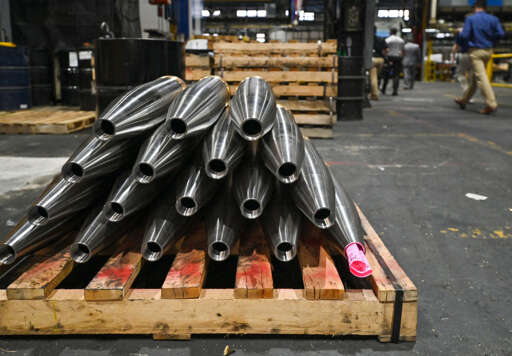
A stack of unfinished mortars seen at a General Dynamics facility in Scranton, Pennsylvania, on August 20, 2025. General Dynamics has plants across the country, including the Texas plant that is the subject of this story. A stack of unfinished mortars seen at a General Dynamics facility in Scranton, Pennsylvania, on August 20, 2025. General Dynamics has plants across the country, including the Texas plant that is the subject of this story. Aimee Dilger / SOPA Images / LightRocket via Getty Images
Truthout is a vital news source and a living history of political struggle. If you think our work is valuable, support us with a donation of any size.
This story was originally published by ProPublica.
A robot was on fire. Again.
It was the summer of 2024, and the cutting-edge robots inside General Dynamics’ sweltering artillery factory near Dallas were catching fire with startling regularity, according to four former workers there. This wasn’t ideal, as the plant was supposed to be churning out urgently needed artillery shells for Ukraine. The robots, giant metal arms with clamps for hands, would end up drenched in oil, which would then — no surprise — combust as they moved steel blocks heated to 1,800 degrees into and out of a machine that periodically erupted columns of fire. One blaze that summer melted a robot’s cables, putting it out of commission for a week.
Only weeks earlier, defense officials and executives had touted the factory’s innovative new machinery, imported from Turkey, at a gala opening ceremony. But employees were already used to spectacular mishaps, fiery and otherwise. “After the second, third, fourth time, it just became almost normal,” one former worker said. “It got to the point where I was not surprised by anything that happened there.”
Instead of producing shells in an efficient and streamlined fashion, the pricey machines kept failing in bizarre ways. The robot arms would swing out of control, smashing into carefully calibrated equipment, and sometimes they would unexpectedly drop hunks of steel 5 feet down to the floor. The factory’s signature device, meant to precisely stretch the steel for the artillery shells, instead often cracked it beyond repair. Then there were the giant press machines, which required regular pounding with a sledgehammer to function properly but still botched the shaping of nearly every shell. “We really didn’t have any standardized practice,” said Quantel White, a former employee. “It was just a bunch of guys taking turns going at the machine with a sledgehammer every night.” To workers, even the factory buildings themselves came to feel doomed, with acrid smoke hanging in 100-degree heat over foundations seemingly sinking into the earth.A press machine at the General Dynamics artillery factory near Dallas Obtained by ProPublica
The situation never improved. The U.S. Army, which funded the factory, ordered work halted on two of its three production lines in August 2025. By then, General Dynamics had blown eight deadlines. Work on the third production line continued, but the facility never produced a single usable shell, according to a report from the Department of Defense’s inspector general in July. Related Story Secretary of Defense Pete Hegseth testifies during a Senate Appropriations Committee hearing in the Dirksen Senate Office Building on Capitol Hill on July 21, 2026 in Washington, D,C. Hegseth: “Greatest Threat” to US Would Be Failing to Give Pentagon $1.5T Budget
The fiasco has cost American taxpayers $533 million, according to the Army. But the Army has not held General Dynamics or a key Turkish subcontractor — which provided the factory’s much-hyped but little-proven equipment — publicly accountable for the failures. Nor has it made General Dynamics pay a penny back.
Just the opposite: General Dynamics, one of the world’s largest defense companies, has been showered with new contracts, continuing its track record as one of the greatest beneficiaries of Pentagon spending. The company is still in charge of the factory. It recently announced that it will fix things there by bringing in another much-hyped but little-proven technology.
“It’s an absolute disaster,” said one former official in an Army office supervising the project. “The Army should’ve gone after recovering money from General Dynamics,” added the official, who, like others interviewed for this story, spoke on the condition of anonymity.
Publicly, the Army has been tight-lipped about what, exactly, went wrong at the factory, located in a sprawling suburb called Mesquite. The inspector general report described the failure but offered few specifics. It didn’t name the companies involved, much less any of the individuals responsible. The report’s recommendations were tepid: The Army should determine whether the contract was “appropriately issued,” how “the money was spent” and whether it can recoup any of it. It should also “identify and implement a solution” for producing more artillery. Army officials deflected blame, telling the inspector general that they didn’t do anything wrong.
In a detailed statement to ProPublica, the Army said it will recover funding for the project by getting unspecified discounts from General Dynamics on production orders. “The Army is exercising rigorous oversight to ensure every dollar invested delivers capability to the warfighter,” the statement read. “Where vendors fail to meet contract specifications, as seen at the Mesquite facility, we are evaluating contract performance, seeking recoupment of funds, and pivoting resources.”
As for General Dynamics, it has given no public explanation whatsoever. The company has said that it “met or exceeded requirements,” according to the inspector general report. General Dynamics declined an interview request from ProPublica. Company spokesperson Jeff Davis said ProPublica’s reporting “fundamentally mischaracterizes the circumstances and falsely impugns our record of employee safety and truthfulness with our customer.” He continued: “An article based on this foundation would be a materially false and misleading hit piece.” Davis did not respond to ProPublica’s request that he specify the alleged errors.
ProPublica reconstructed how the project went awry through interviews with 36 current and former employees of General Dynamics, the Army, the Pentagon and the White House. ProPublica also reviewed internal company documents as well as photographs and videos taken inside the factory.
Those involved described a project that was rushed and ill considered from the start. Congress paved the way, removing government contracting guardrails — meant to ensure taxpayer money isn’t wasted — so that Ukraine-related defense projects could be funded quickly. The Army took advantage, handing General Dynamics lucrative no-bid awards without knowing whether the machines it planned to use could perform the desired work. The Army’s due diligence was inadequate, four former Army and General Dynamics officials told ProPublica.
Compared to the multibillion-dollar budgets of other DOD projects, the financial cost of the Texas debacle is small. But the lack of consequences for the companies involved, in the view of defense-spending critics, is symptomatic of a larger problem: a deep-rooted culture at the Pentagon and in Congress in which expensive failures lead only to more spending. Such critics fear that extreme cases like this one could become more common if the Trump administration succeeds in boosting the defense budget from $1 trillion to $1.5 trillion. The administration is also seeking tens of billions of dollars for its war against Iran and pressuring defense companies to quickly ramp up weapons production.
“Too often the contractors have no accountability for their mistakes,” defense budget researcher William Hartung said. The Texas failure, he said, “is a foreshadow of what’s to come if the Trump administration gets the budget it asked for.” The Pitch
Russia’s invasion of Ukraine in February 2022 felt like an emergency to the Biden administration. For General Dynamics, it was an opportunity. And Firat Gezen was ready with a pitch.
In six years running General Dynamics’ Ordnance and Tactical Systems business, Gezen had earned a reputation as a deft strategist and salesman. At 50, he wasn’t an engineer, and he had no experience running factories. He had spent decades working on the financial side of the weapons business. With a ready smile and a delivery as smooth as his perfectly bald head, he knew how to woo corporate leaders and Pentagon arms buyers alike.
Gezen was also shrewd. In 2020, after the Army sought to diversify its artillery supplier base by contracting with a small Pennsylvania company, Gezen swooped in and bought that company. That allowed General Dynamics to maintain its stranglehold over the production of metal bodies for the standard American artillery shell, referred to by its caliber: 155 mm. “Firat throws his arm around you and talks to you nicely,” one former Army official said. “But he’s got, like, five things that he’s the sole provider of, and it’s exclusive. He’s got you locked up forever.”
That put General Dynamics in an ideal position. Russia and Ukraine were firing thousands of shells back and forth each day. The United States was a key supplier to Ukraine, but decades of disinvestment had left the U.S. artillery industry emaciated. In March 2022, Congress passed the first in a series of bills allocating billions of dollars for Ukraine-related causes, including boosting artillery production. The