I have never seen anything other than carton boxes for eggs here in Norway. This comment actually baffled me that they came in anything other somewhere.
That’s just fucked up. Clear plastic seems like the worst possible container as it gives little or no protection, and is obviously plastic which the world only needs less of.
It’s usually multiple foldovers of semi rigid plastic similar to most water bottles around here. They seem to function well. It’s probably six or more 1 litre bottles worth of plastic though.
Only one of them is the cheap regular eggs, though. The others are organic or free range or otherwise differentiated in some way other than just the foam vs paper packaging.
You should always buy the organic ones, even if they are so much more expensive. The conditions in which the chickens are kept, to produce the cheap eggs, is absolutely, inhumanely fucked up. You can see the difference in the yolk as well: the ones produced by chickens, that are fed better, and not kept in a way they cannot even move, are orange, while the ones by chickens kept and fed horribly, are yellow.
The yolk thing is a myth. Farmers feed their hens dandelion extract to get the color. My family actually has pasture raised hens and the yolks are yellow.
Organic is kind of a scam. At least not what people imagine. What you want is floor raised, or even better, free range. And grain fed. In every country the definitions are slightly different. Look into it. What you want is hens that are out in the open, so that they follow natural day cycles, that can move around a bit, and fed grain instead of feed, which is often made from fish flour and such.
Oh, that is good to know. Here organic includes the highest standards for chicken wellfare, since they have to be let out etc., compared to just freerange that has tiny floorspace requirements, inside.
I believe the EU requirements are minimum space (6 hens/sq. meter, not exactly running space), and organic feed, which is basically no GMO, no synthetic fertilizers/pesticides. grain-fed labeling is only compulsory if you label as such. Fish flour feed, if it’s from fisheries, is allowed, since it’s from wild origin.
I used to be a partner at a company the produced BIO produce. The things we were allowed to do within EU rules would surprise most consumers. Things like using copper sulfate, and other “natural” pesticides without limits, phosphate and other fertilizers which are not synthetic, greenhouses with artificial lighting, etc.
From your user name I’m going to assume that you are a Finn. It’s possible that Finland has stricter rules for BIO/organic (good), but EU regulations are way less strict than what people assume. People see the BIO/organic label and assume that grandma was hand feeding the hens from her apron.
We follow the EU rules on that, as far as I know. And oh certainly, it is far from perfect; practically all animal products produced in big scale, are unethical, and I would not trust the organic labeling on plant products. But if you are going to buy eggs, even the EU bio criteria are significantly better, than having the chickens locked in tiny cages for their lives, or kept in huge indoor halls. The criteria, for example, also includes 4sq.m of outside space per chicken, and that they get to spend 1/3 their lives outside, whenever possible. Here the outdoor season is from May to October, I do not know does that differ in other EU countries. Is that great? No. But it is better, than the alternative requirements.


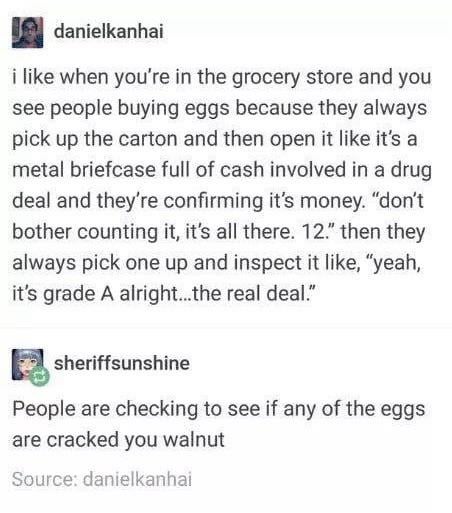
Only works on paper cartons. Shouldn’t be buying Styrofoam but still.
I have never seen anything other than carton boxes for eggs here in Norway. This comment actually baffled me that they came in anything other somewhere.
In Canada, they come in bags.
My neighbor gets hers out of chickens
She probably Chinese.
Eastern European
Yea, “Chinese”, that’s what they said, it’s to the east of europe, damn, you americans don’t know geography at all
/s
Yes china… Listed under the *more section for eastern europe in the select your location box…
Ours come in a clear plastic vacuum formed container, compressed paper carton, or Styrofoam, depending on the brand.
That’s just fucked up. Clear plastic seems like the worst possible container as it gives little or no protection, and is obviously plastic which the world only needs less of.
It’s usually multiple foldovers of semi rigid plastic similar to most water bottles around here. They seem to function well. It’s probably six or more 1 litre bottles worth of plastic though.
It is the worst. The only pro is you can visible see if they are broken without opening anything.
As if the grocery store gives you a choice.
There’s like six different egg providers at most grocery stores around me. I have choices.
Only one of them is the cheap regular eggs, though. The others are organic or free range or otherwise differentiated in some way other than just the foam vs paper packaging.
You should always buy the organic ones, even if they are so much more expensive. The conditions in which the chickens are kept, to produce the cheap eggs, is absolutely, inhumanely fucked up. You can see the difference in the yolk as well: the ones produced by chickens, that are fed better, and not kept in a way they cannot even move, are orange, while the ones by chickens kept and fed horribly, are yellow.
The yolk thing is a myth. Farmers feed their hens dandelion extract to get the color. My family actually has pasture raised hens and the yolks are yellow.
That is good to know, too!
Organic is kind of a scam. At least not what people imagine. What you want is floor raised, or even better, free range. And grain fed. In every country the definitions are slightly different. Look into it. What you want is hens that are out in the open, so that they follow natural day cycles, that can move around a bit, and fed grain instead of feed, which is often made from fish flour and such.
Oh, that is good to know. Here organic includes the highest standards for chicken wellfare, since they have to be let out etc., compared to just freerange that has tiny floorspace requirements, inside.
I believe the EU requirements are minimum space (6 hens/sq. meter, not exactly running space), and organic feed, which is basically no GMO, no synthetic fertilizers/pesticides. grain-fed labeling is only compulsory if you label as such. Fish flour feed, if it’s from fisheries, is allowed, since it’s from wild origin.
I used to be a partner at a company the produced BIO produce. The things we were allowed to do within EU rules would surprise most consumers. Things like using copper sulfate, and other “natural” pesticides without limits, phosphate and other fertilizers which are not synthetic, greenhouses with artificial lighting, etc.
From your user name I’m going to assume that you are a Finn. It’s possible that Finland has stricter rules for BIO/organic (good), but EU regulations are way less strict than what people assume. People see the BIO/organic label and assume that grandma was hand feeding the hens from her apron.
We follow the EU rules on that, as far as I know. And oh certainly, it is far from perfect; practically all animal products produced in big scale, are unethical, and I would not trust the organic labeling on plant products. But if you are going to buy eggs, even the EU bio criteria are significantly better, than having the chickens locked in tiny cages for their lives, or kept in huge indoor halls. The criteria, for example, also includes 4sq.m of outside space per chicken, and that they get to spend 1/3 their lives outside, whenever possible. Here the outdoor season is from May to October, I do not know does that differ in other EU countries. Is that great? No. But it is better, than the alternative requirements.