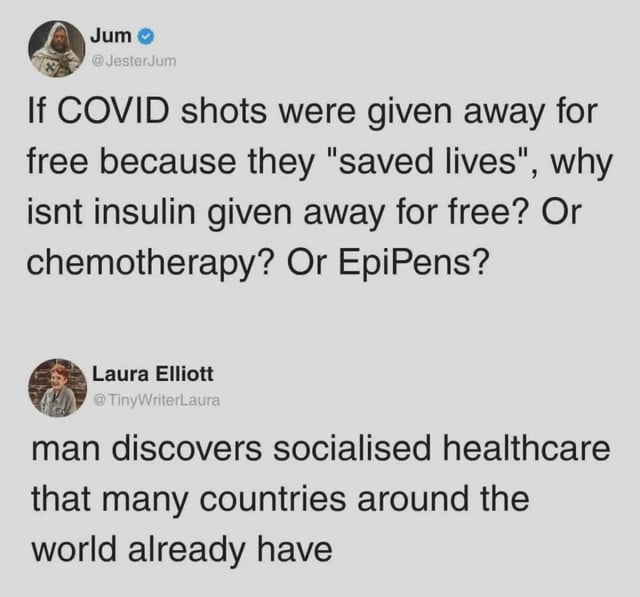
COVID shots also save the lives of other people because of reducing disease transmission (fewer people sick means less transmission), which is acceptable for the most simpleton “What’s in it for me crowd”.
Meanwhile the socialized healthcare things are only acceptable for people who don’t want to see others suffer (i.e. who have empathy) and/or who can see how living in a country were other people have better lives also improves their own lives (i.e. who have social awareness) and/or who are aware than “one day I might be the one there” (i.e. reasonable intelligent and risk aware).
So it absolutelly makes sense that in countries were people are heavilly brainwashed to have simpleton zero-sum-game selfish views on social issues, COVID shots are an easier idea to sell (and even then, as we saw mainly in the US, it’s pretty easy to swindle the dumbest of the “What’s in it for me” crowd to think the COVID shots are actually bad for them and refuse to take them).
Adding to your second paragraph, it also turns out that people who are healthy are more able to contribute to society, so even if you have zero empathy you’re going to want to provide for many of the basics that the US has increasingly striven to make unaffordable.
That would be part of the second rationale in the second paragraph, IMHO.
I guess calling it “social awareness” threw me off because to me that’s something completely different from what I’m saying.
It’s just basic economics (of countries whose economies are not based on resource extraction, which you can technically effectively do with a miserable and unhealthy populace).
Yeah, I just checked the definition of “social awareness” and I might have misused the expression, though I don’t quite know what would be the correct one to use to mean the awareness of how at multiple levels the lives of people around us can impact our own lives.
The problem a lot of times is that the social impact doesn’t get time to be addressed before it gets stopped in peoples minds. Many people get to “healthcare is expensive, I can’t/don’t want to pay someone else’s healthcare. Forget the economy or social benefit, I can’t afford to pay it.” So the benefits are there, but when people are struggling it’s hard to ask them to see beyond their nose.
To me “social awareness” relates to how your actions impact the feelings of others, not so much the brutal math of the situation (which I would call Economics, which luckily happens to align with the empathetic angle in most countries).
I was using it to mean just the general improvement of the environment you live in, which does include monetary prosperity but also things like less Crime, things just being more well cared for and how generally being surrounded by people less stressed in a better mood makes one’s mood better.
When smallpox was eradicated in the 1950s, it was achieved with something like 100 million doses of the vaccine, which was substantially less than the world population at the time (in the neighborhood of 2.5 billion). This is because scientists understood that the vaccine was not something for individual protection but was rather a weapon to protect the population as a whole (and annihilate the disease entirely) when coupled with a full understanding of how the disease spread.
Completely unrelated to this meme, but does anyone have the meme of republicans not understanding hypotheticals that goes like
“Imagine you are [x]”
“But I’m not [x]? I’m [y]”
There’s also the fact that rich people buying insulin for themselves is enough to keep them safe. Rich people vaccinating only themselves though won’t be anywhere near as effective.
Unvaccinated people just give a vaccine-resistant strain the chance to develop.
man if seizures and hypoglycaemic episodes were contagious that medicine would be cheaper
Man discovers that the same government that doesn’t pay for insulin or chemotherapy is willing to pay for COVID vaccine 🤔
time is merely mans attempt to control his environment. clocks sole purpose is to create controllable sequences of events
is that also why the timestamps are conspicuously missing from this screenshot?
Because covid is contagious. If one thing is worse than death, it’s death that spreads, also know as a plague. Orders of magnitude worse. They change everyone’s history, not just your family’s.
slavers just changed tactics. called employers on paper.
oooooooaaaahhhmmM 🐄
Well, it isn’t free in the socialized healthcare countries, but taxes don’t go into the audit-dysfunctional defense budget and so you actually get your money worth (and others do too). But alas, people have their outgroups so we can’t have nice things.
The defense budget is entirely irrelevant to healthcare. We already spend multiple times the defense budget on Medicare and Medicaid, and another several times as much on health insurance premiums, copays, and coinsurance.
We could have universal healthcare without touching the defense budget at all, and it would still be cheaper than the system we currently have.
I’ll just say, the United States Marine Corps has passed two audits on a row, the only branch to pass an audit, period. And so it’s obviously possible, and the fact that others can’t do it needs to be investigated more thoroughly.
Im still thinking about the title, plainly it makes sense but idk what OP meant by it!
Because diabetes isn’t contagious. It was never altruistic.
Excuse me, time is not a circle. Time is a cube.
But cubes have eight corners XD
You really wanna argue with that wall of text? Hehe
They are getting you used to taking emergency shots.
…no
Because one of those things is contagious, impacting consumers and laborers and therefore halting commerce until addressed. It was determined to be more profitable to give away free shots. Yay capitalism.
Yes, herd immunity is inapplicable to diabetes, cancer, or allergies.
Edit: Is there a way to generically refer to not OP but the original original poster? The guy, for example, who’s confused in this post (Jum). Is OOP standard?
Herd immunity wasn’t aplicable to COVID either
Care to explain, or do we not believe in the germ theory of disease now?
Cool, thank you!
OOP
Object Oriented Person
Ornery and Officious Periodontologist
Orange Octagonal Polygon
OOP, yes
Unless of course OP’s comment refers to multiple other comments, in which case it’s OOPS
Fun fact: the Danish word for oops is “ups”, which makes it fun to receive packages from United Parcel Service here 😁
It’s the same in german, i was always saying i wouldn’t get my parcel because ups!
(although GLS is far worse)
Unfortunately I don’t think that it is standard, people also use OP to refer to a commenter higher up a single comment thread, so then the normal OP becomes the OOP, meaning the OP in the post would become the OOOP. Or we could use “Pre-Original-Original-Poster”…
people also use OP to refer to a commenter higher up a single comment thread too
I’ve never understood that. That’s literally not the OP. The original poster is the one who posted the post, not a comment.
Using the word that way is antithetical to its very meaning. It’s like if I randomly started calling my cousin my grandfather, but unironically (side rant: “unironically” is used to mean “non-sarcastically,” because people can’t grasp the difference between sarcasm and irony 🤦♀️).
Anyway, you could refer to the “top-level comment,” but I don’t think there’s an acronym for that. But I’ve seen OC used, it’s just rare. OC can refer to any higher-level comment though as long as the context makes it clear which one it’s in reference to.
But the one who posted the post is not OOP. That’s OP. OOP is the one who posted the post that OP’s post refers to.
I guess the POOP would then be any OOPs from OOP’s post or prior…
Oh yeah I fully agree it’s stupid. OC of course can bring up more confusion since it usually means Original Content.
Oh yeah you’re right, I was thinking Orange County which shouldn’t cause much confusion, but Original Content could definitely be ambiguous with Original Comment. You’re right…
Oops
I think I was always dimly aware of the notion, but one of the things that covid really highlighted for me was that people in power are able to put an actual cash figure on every human life.
“If we spend more than £X on a given solution to this problem, it will stop being financially worthwhile”
And £X+ was the point at which disabled people, or younger people, or both, or whoever, were just left to die. Governments spent a lot of money, for sure, but not a penny more than was necessary to keep the economy (somewhat) upright and their cronies in cocktails and bigger yachts.
That each human being has an estimated cash value is something that was taught in school when I went at least. It was more related to how much a death costs estimated based on how much value the person could have brought in if alive.
What’s really wild is that every government has multiple numbers depending on what they’re spending on. The amount that their departments associated with it will spend to rescue a citizen held hostage is different from the amount they’ll spend to save a life from disease which is different from the amount any particular infrastructure related department will spend to save a life, which may all be different from each other, and may be different based on cause of death (my government will spend a lot more to save a life from a passenger train related death than from a freight train related death or an automobile death)
ETA: https://en.wikipedia.org/wiki/Value_of_a_statistical_life
I couldn’t believe that on the discovery of a deadly airborn virus, they decided to keep the airports open.
“If we spend more than £X on a given solution to this problem, it will stop being financially worthwhile”
Yup, it’s like the old recall equation from Fight Club.
a * b * c = x
It doesn’t matter how catastrophic the crashes are nor how many people, including kids, die as a result of them. The only thing that does matter is if the cost of a recall is cheaper than the estimated total cost of settlements.
Even worse, the £X is the short-term financial gains. Reducing poverty and homelessnes DOES profit over long run, but we don’t have anyone at top competent enough to tradeoff it with “slightly less profit margins increased by next year.”
Yeah… Only
- Covid significantly affected the elderly and those from poorer neighbourhoods. Net draws on government funds, not net producers of income. If the government were being callous capitalists they’d have let covid rip and saved themselves a packet in pension payouts and welfare.
- The government were widely criticised at the time for not doing enough (too late with lockdown, too lax with mandates). The government cannot simultaneously find it prudent to not care about covid and care terribly that it is kept in check. Their callous calculation should have come out with either ‘save everyone’ or ‘let everyone die’. It can’t be both.
- Pharmaceutical companies made a fortune, as did anyone with shares in them. No one ‘paid out’ there was no trade off of expense against predicted income. The taxpayer paid for the research, paid for the shots, and paid for the shutdowns. The corporations didn’t pay for anything at any time.
They did sort of try to just let it run its course. Dan Patrick even said on TV that a bunch of old people should sacrifice themselves to save the economy. Hell, even after it was found to have really spread and start killing everybody else too, Dr. Oz said we should send kids back to school because it would only result in 2-3% total mortality. They tried to do nothing. They tried to demonize wearing a mask. They tried to keep businesses and schools open. They really didn’t want to do anything differently, and they didn’t until cases and deaths skyrocketed. And there are still an embarrassing amount of people who think that the shots didn’t help and were actually harmful, most COVID deaths were not from COVID, and masks are for “woke libtards”. The post that we’re commenting on is far from an anomaly.
I don’t disagree with your description of events, but you’re imposing a reasoning behind them for which there is little evidence. The idea I’m pushing back against is that vaccines (here Covid) and I suppose now Covid policy in general, resulted from some clever metric of keeping people alive because of their income generating value. There’s no evidence government works like that, and masses of evidence that government decisions are in fact a mix of submission to industry lobbying, blatant electioneering, and simple incompetence.
Whatever the policies were, they would almost certainly have been whatever the loudest industry lobby, focus group committee, or egotistical politician wanted at the time. Not some sociopathic genius doing life-value calculus.
I’m not saying that it was the government who did that calculation. I think that companies did that calculation. I think that losses in revenue and even worse forecasting led companies to loudly call for blanket changes in policies so that the bleeding could be stopped. And then they got massive loans to get through the tough times, and most of those were forgiven, so it was effectively a business stimulus package.
I think it had nothing to do with life value and everything to do with consumer confidence. A loud minority still wanted to go out, but that wasn’t adding up to a whole lot of money, and they were gonna soon run out of customers at the rate they were getting hospitalized. Not to mention the impact to the workforce.
I was just talking with my wife about flu shots. Health insurance covers an annual flu shot, and it’s because it lowers their cost to have as many people vaccinated as possible, even though they have to pay for that shot. Similar sort of calculation.
What losses in revenue? As I said earlier, deaths an hospitalisations were overwhelmingly in older age brackets and poorer neighbourhoods. Companies were compensated for closures, and able to profit enormously from the ‘supply chain problems’ by price gouging. They made a fortune on the vaccine itself, not to mention the increase in future products off the back of the RNA research. What losses in revenue were on the horizon?
Health insurance costs in America have risen by over 130%, so there’s no evidence of insurance companies offering flu shots to save money, they just demand more premium to cover it.
Far more likely, in my view, is that taking regular vaccines has become a marketable product (for various reasons) which insurance companies have jumped on. Offer the shot, up the premium to cover it (plus a healthy profit). It simple market expansion.
If there’s a market (or one can be fabricated), then there’s a product to sell. If you can add a flu shot, up the premium to cover it, and not lose customers, then it makes sense to do so. Doesn’t have any bearing on whether it works. Same metric would apply to a medicine which did absolutely nothing whatsoever. As long as advertising it justified a rise in premiums larger than the cost of it, and customers don’t jump ship.
This is want I mean by comfortable narratives around medicine. If literally any other industry had added a service to their product, you’d assume it was simply something they thought they could market, and probably be suspicious that it was any use at all. But when a medical company adds a service (and charges more for it) people have to do this mental gymnastics to make the company’s actions all for the best in the end.
deleted by creator
*Yay American capitalism.