COVID shots also save the lives of other people because of reducing disease transmission (fewer people sick means less transmission), which is acceptable for the most simpleton “What’s in it for me crowd”.
Meanwhile the socialized healthcare things are only acceptable for people who don’t want to see others suffer (i.e. who have empathy) and/or who can see how living in a country were other people have better lives also improves their own lives (i.e. who have social awareness) and/or who are aware than “one day I might be the one there” (i.e. reasonable intelligent and risk aware).
So it absolutelly makes sense that in countries were people are heavilly brainwashed to have simpleton zero-sum-game selfish views on social issues, COVID shots are an easier idea to sell (and even then, as we saw mainly in the US, it’s pretty easy to swindle the dumbest of the “What’s in it for me” crowd to think the COVID shots are actually bad for them and refuse to take them).
Adding to your second paragraph, it also turns out that people who are healthy are more able to contribute to society, so even if you have zero empathy you’re going to want to provide for many of the basics that the US has increasingly striven to make unaffordable.
I guess calling it “social awareness” threw me off because to me that’s something completely different from what I’m saying.
It’s just basic economics (of countries whose economies are not based on resource extraction, which you can technically effectively do with a miserable and unhealthy populace).
Yeah, I just checked the definition of “social awareness” and I might have misused the expression, though I don’t quite know what would be the correct one to use to mean the awareness of how at multiple levels the lives of people around us can impact our own lives.
The problem a lot of times is that the social impact doesn’t get time to be addressed before it gets stopped in peoples minds. Many people get to “healthcare is expensive, I can’t/don’t want to pay someone else’s healthcare. Forget the economy or social benefit, I can’t afford to pay it.”
So the benefits are there, but when people are struggling it’s hard to ask them to see beyond their nose.
To me “social awareness” relates to how your actions impact the feelings of others, not so much the brutal math of the situation (which I would call Economics, which luckily happens to align with the empathetic angle in most countries).
I was using it to mean just the general improvement of the environment you live in, which does include monetary prosperity but also things like less Crime, things just being more well cared for and how generally being surrounded by people less stressed in a better mood makes one’s mood better.
When smallpox was eradicated in the 1950s, it was achieved with something like 100 million doses of the vaccine, which was substantially less than the world population at the time (in the neighborhood of 2.5 billion). This is because scientists understood that the vaccine was not something for individual protection but was rather a weapon to protect the population as a whole (and annihilate the disease entirely) when coupled with a full understanding of how the disease spread.


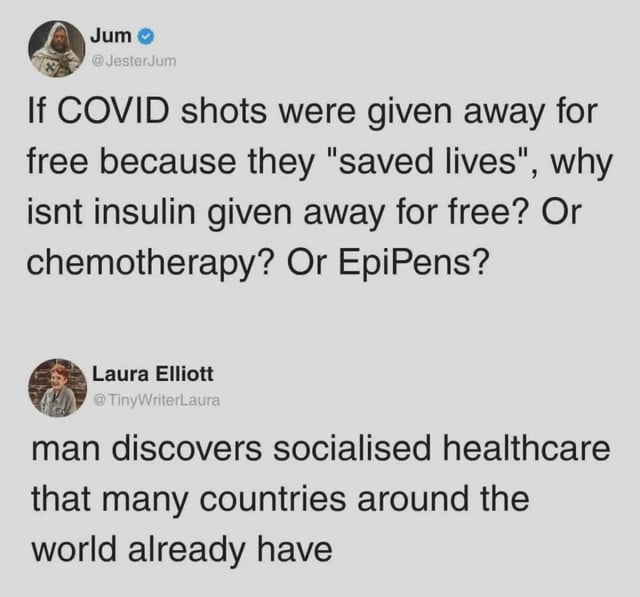
COVID shots also save the lives of other people because of reducing disease transmission (fewer people sick means less transmission), which is acceptable for the most simpleton “What’s in it for me crowd”.
Meanwhile the socialized healthcare things are only acceptable for people who don’t want to see others suffer (i.e. who have empathy) and/or who can see how living in a country were other people have better lives also improves their own lives (i.e. who have social awareness) and/or who are aware than “one day I might be the one there” (i.e. reasonable intelligent and risk aware).
So it absolutelly makes sense that in countries were people are heavilly brainwashed to have simpleton zero-sum-game selfish views on social issues, COVID shots are an easier idea to sell (and even then, as we saw mainly in the US, it’s pretty easy to swindle the dumbest of the “What’s in it for me” crowd to think the COVID shots are actually bad for them and refuse to take them).
Adding to your second paragraph, it also turns out that people who are healthy are more able to contribute to society, so even if you have zero empathy you’re going to want to provide for many of the basics that the US has increasingly striven to make unaffordable.
That would be part of the second rationale in the second paragraph, IMHO.
I guess calling it “social awareness” threw me off because to me that’s something completely different from what I’m saying.
It’s just basic economics (of countries whose economies are not based on resource extraction, which you can technically effectively do with a miserable and unhealthy populace).
Yeah, I just checked the definition of “social awareness” and I might have misused the expression, though I don’t quite know what would be the correct one to use to mean the awareness of how at multiple levels the lives of people around us can impact our own lives.
The problem a lot of times is that the social impact doesn’t get time to be addressed before it gets stopped in peoples minds. Many people get to “healthcare is expensive, I can’t/don’t want to pay someone else’s healthcare. Forget the economy or social benefit, I can’t afford to pay it.” So the benefits are there, but when people are struggling it’s hard to ask them to see beyond their nose.
To me “social awareness” relates to how your actions impact the feelings of others, not so much the brutal math of the situation (which I would call Economics, which luckily happens to align with the empathetic angle in most countries).
I was using it to mean just the general improvement of the environment you live in, which does include monetary prosperity but also things like less Crime, things just being more well cared for and how generally being surrounded by people less stressed in a better mood makes one’s mood better.
When smallpox was eradicated in the 1950s, it was achieved with something like 100 million doses of the vaccine, which was substantially less than the world population at the time (in the neighborhood of 2.5 billion). This is because scientists understood that the vaccine was not something for individual protection but was rather a weapon to protect the population as a whole (and annihilate the disease entirely) when coupled with a full understanding of how the disease spread.