

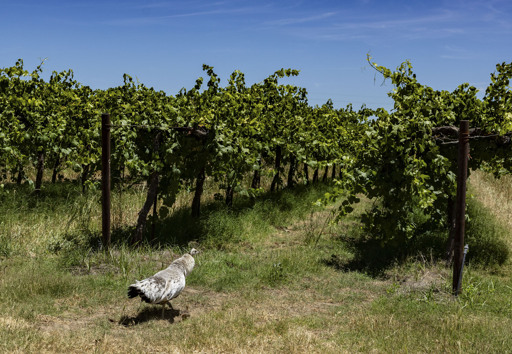
Many California growers can’t find buyers as the industry produces more wine grapes than the market wants. Wine consumption is declining globally as people drink less.
It’s harvest time in California wine country, but many growers are struggling to sell their grapes as changing drinking habits have caused demand to plunge. The decline is forcing some growers to tear out vineyards that their families have grown for generations.
Wine sales have decreased by more than 20% over a five-year period, causing prices paid for grapes to drop and prompting California growers to take roughly a quarter of the state’s vineyards out of production. Many growers are having to decide whether to harvest at a loss, leave grapes on the vine or replace vineyards with crops more in demand such as almonds, walnuts, pistachios and olives.
Third-generation grower Bill Berryhill said it means another year of losing money and wasting hundreds of tons of healthy grapes.
Agriculture land in california is pretty damn productive. Solar can go in deserts.
It can’t. The us doesn’t have barren deserts, and running power out to them isn’t cost efficient. The disruption to wildlife is pretty severe too.
Just put solar on existing structures in the cities. There’s plenty of sun to go around and existing power infrastructure.
Mixed solar-crop fields have been reported to do pretty well. Though I haven’t seen for grape+solar.
It depends heavily on the crop, and on the climate. I believe it works well for lettuce, for example, because lettuce needs shade, but other crops (I think ones with more sugar in them, hence need more sunlight) are adversely affected
Nutrition and flavor is complex. One study I’ve seen stated that sheep grazing on solar grass fields ate almost 1/3 less grass but gained equivalent weight to sheep eating non-solar grass because the overall nutrition was higher.
If high sugar was purely sunlight and CO2 crops would be getting sweeter with human-made greenhouse gasses and thinning ozone.
Crops are getting sweeter but I think it’s more due to selective breeding
aka raisin land :)
(simple stupid pun/joke)
Only because I did the math a while back - dedicating around 10% of the land we grow corn on for ethanol - converting that to solar - would give us enough energy to supply 100% of US can transporation energy needs (i.e. if everyone converted to electric cars). We’d have 90% of that corn-grown-for-ethanol land freed up to do whatever, and not impact any land used to grow food we (or animals) eat.
That said, using desert for solar also makes tons of sense.
Very little corn grown in the US is actually edible. It’s mostly used for oils and sugars.
Not that I know much about it, but you don’t grow corn in the most productive areas. You grow that in hardier areas. California is the best for fruit and vegetables.
Another reason not to use our best ag land for solar. :)
Solar and crops can do exist, some crops thrive in indirect light and use less water.
The irony is, a lot of agricultural land in California is quasi desert (central valley). They irrigate.