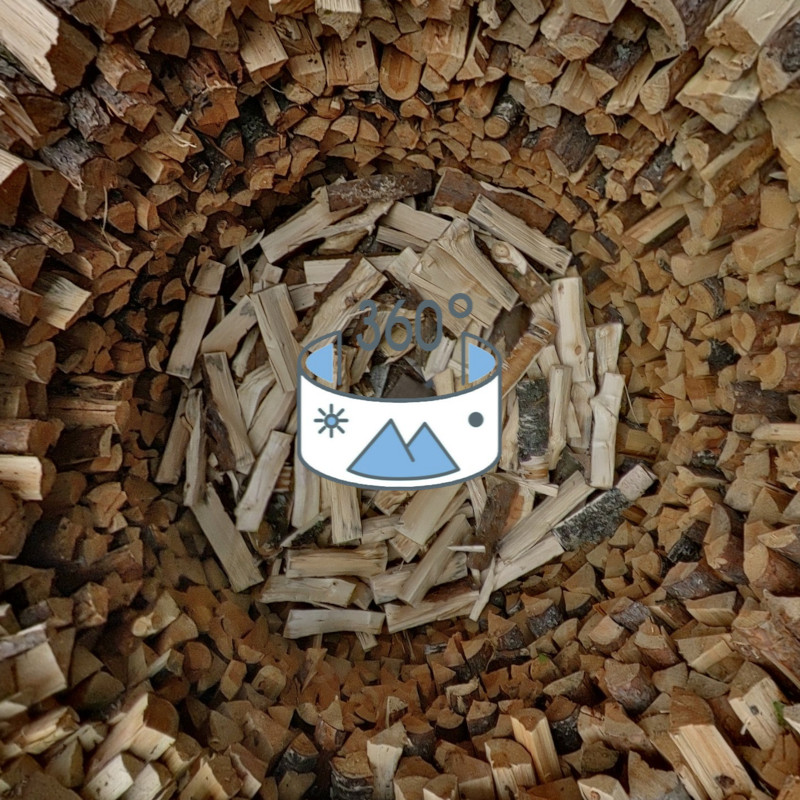

As I add layers of logs to the stack, the logs lean outward more and more. It’s simple geometry: the stack is round, with an inner diameter smaller than the outer diameter, and the logs are arranged in a spokes pattern - pointing at the center. But the logs are straight, not wedge-shaped, so the inner ends ride on the logs below a bit higher than the outer ends. The more layers, the steeper the lean becomes.
The last time I worked on the stack, it got high enough that the lean became excessive and I couldn’t add more logs: they simply wouldn’t stay put and would slide right off. In fact, the entire top of the stack was threatening to collapse outward.
I didn’t think the lean would become excessive this quickly, but it did. This is my first Norwegian wood stack, and I guess I’m discovering what everybody knew already 🙂
So I pulled down about half of the stack, to get back to a layer of logs with an acceptable lean angle, added a ring of logs all around the outer perimeter to lift the outer ends of the logs above and correct the lean - basically go back to flat logs above this “correction ring”.
And then I discovered the fine art of stacking logs horizontally consistently layer after layer despite the curvature of the stack. It’s not a super-obvious technique, and it takes a lot of time to place each log properly. But it’s well worth the effort.
Now the bottom of my stack has the lean in the logs, then there’s this correction layer, then the top of the stack has only horizontal logs. If I wanted this stack to be perfect, knowing what I know now, I would have to pull it down completely and re-stack it. But this is good enough: the correction layer is rather decorative, and it’ll serve as a reminder of what not to do below it 🙂
Now the stack is 4 ft high and very stable. I’ve stopped growing it and I’ve started filling up the inside, because I’m afraid I’ll run out of wood before the inner space is full. Here’s a 360° photo taken from the inside: