But it does not show a sufficient formal proof and no experimental validation. Many important questions to evaluate the concept are left unanswered, which limits the interpretability and condenses it to “just trust me, bro, it’s a good idea, because I say so”.
Interactive demonstrations are not the same as a formal proof or experimental validation. So we shouldn’t attribute more to this technique than the available evidence can really support.
I found some time to quickly skim through the sources they have listed. And from that it became pretty clear that this is not realiable in detecting LLM generated versus human output in general. Under very tight assumptions specific error rates were reported that appeared rather low.
However, these assumptions do not hold in general, even with more text if no relevant signal remains. There is currently no scientifically validated general purpose way of reliably detection.
More importantly in the context of Claude, the production watermarking scheme is undisclosed. Therefore, the cited experiments on known watermarking schemes can neither establish how reliably text generated by Claude can be detected, nor how reliably the technique described in the article removes the actual watermark.
It can be treated as an indicator at best, but not as validated proof.


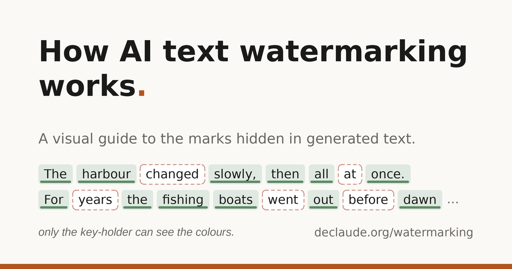
I thought the article explained that pretty reasonably on a scale of probability and weight. The longer the text, the more reliable the scoring.
But it does not show a sufficient formal proof and no experimental validation. Many important questions to evaluate the concept are left unanswered, which limits the interpretability and condenses it to “just trust me, bro, it’s a good idea, because I say so”.
I’m not sure we’ve read the same article. There are literally interactive demonstrations within the page to demonstrate how the concept works.
Interactive demonstrations are not the same as a formal proof or experimental validation. So we shouldn’t attribute more to this technique than the available evidence can really support.
I found some time to quickly skim through the sources they have listed. And from that it became pretty clear that this is not realiable in detecting LLM generated versus human output in general. Under very tight assumptions specific error rates were reported that appeared rather low. However, these assumptions do not hold in general, even with more text if no relevant signal remains. There is currently no scientifically validated general purpose way of reliably detection.
More importantly in the context of Claude, the production watermarking scheme is undisclosed. Therefore, the cited experiments on known watermarking schemes can neither establish how reliably text generated by Claude can be detected, nor how reliably the technique described in the article removes the actual watermark.
It can be treated as an indicator at best, but not as validated proof.