

https://www.thefarside.com/2026/08/12/0
No caption
Alt text:
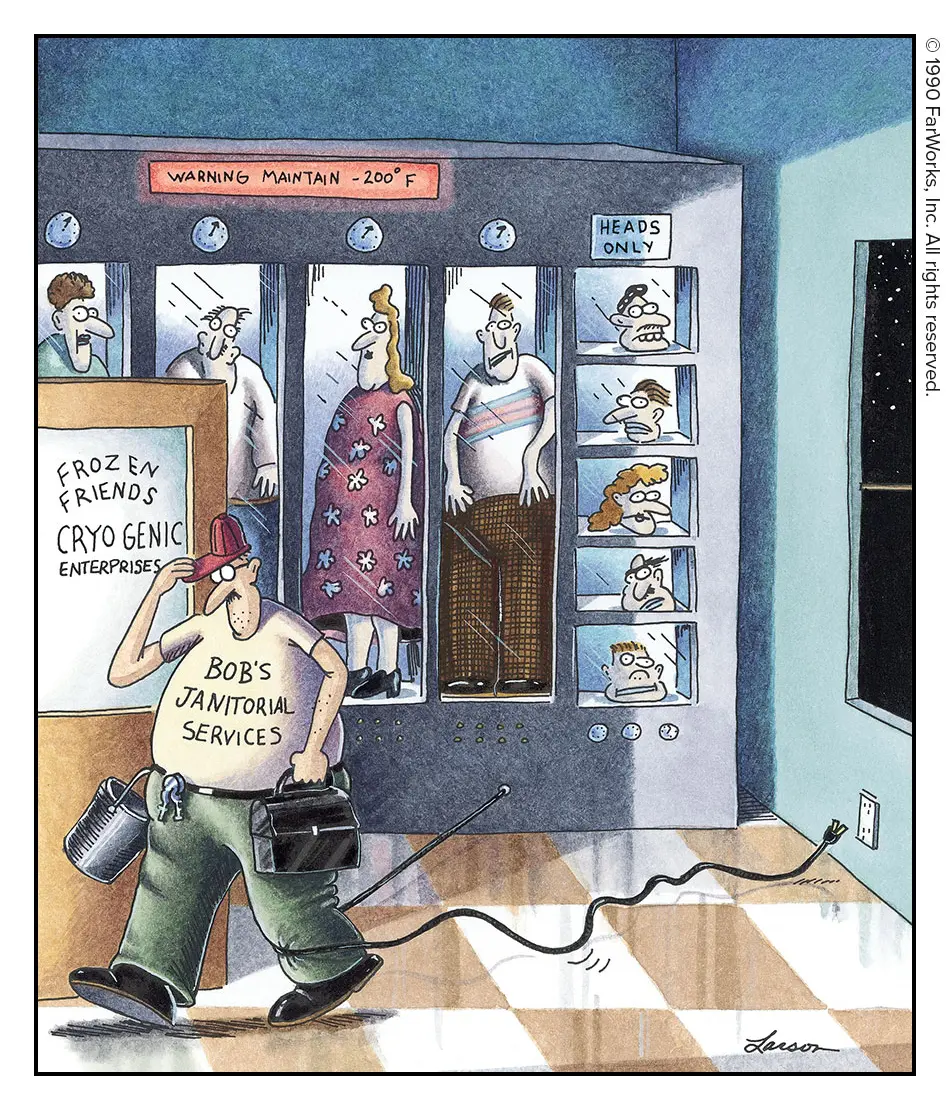
WARNING - MAINTAIN - 200 F. / HEADS ONLY / FROZEN FRIENDS CRYOGENIC ENTERPRISES / BOB’S JANITORIAL SERVICES
Page couldn’t be archived
https://www.thefarside.com/2026/08/12/0
No caption
Alt text:
WARNING - MAINTAIN - 200 F. / HEADS ONLY / FROZEN FRIENDS CRYOGENIC ENTERPRISES / BOB’S JANITORIAL SERVICES
Page couldn’t be archived
I read an article about this a while ago. Apparently the main obstacle is the formation of destructive ice crystals. They can avoid this by cooling fast enough to extreme low temperatures, which is already used in practice on very small things:
There have been recent breakthroughs in preserving whole organs, albeit not indefinitely so far:
There’s also techniques that don’t rely on cooling:
They’re not close to bringing frozen people back from the dead though:
Yeah, this is fantastic tech, nice examples! Another is that most donor organs are discarded but wouldn’t be if we could cryopreserve them!
And yeah, those people already cryopreserved today will be the hardest to “get back”, they were also already dead (because legislation, can’t cryopreserve a living human being even if they’re dying right now).
That shouldn’t stop research though IMO.
I don’t know what the hold up is. A man was successfully flash frozen in carbonite and unfrozen several months later, with temporary blindness being the only side effect. This was around 1980, I think.