

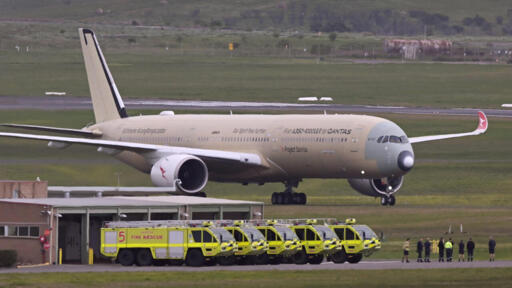
Paris (France) (AFP) – A specially modified Airbus A350 plane touched down in France Tuesday after a record 24-hour test flight from Australia, ahead of it joining Qantas’s fleet next year.
Its 23,076-kilometre (14,339-mile) journey – across three continents and two oceans, and through two sunsets and two dawns – was one of the most-watched flights shown on the Flightradar24 tracking site.
It was also a crucial step before Australian airline Qantas receives its first A350-1000ULR in April next year, to be followed by 11 others for services able to link Australia non-stop to destinations in the United States and Europe.
The ULR in its designation stands for “ultra long distance”, a feat made possible by an additional 20,000-litre rear centre fuel tank being fitted to Airbus’s A350-1000 model.
The flight from Australia to France took precisely 24 hours and 24 minutes.
On its outbound flight, last week, from Toulouse to Melbourne, the test aircraft flew 17,000 kilometres in 19 hours and 12 minutes.
The return trip simulated a trajectory the plane would take once put into commercial service. Qantas plans to start offering non-stop flights between London and Sydney from October 2027. Later, it intends to start also flying between Sydney and New York.
On board the plane was a cockpit crew of eight people from Airbus’s testing division, accompanied by two Qantas pilots. Two Airbus engineers were also on board.
Some of the aspects studied on the flight were the modified architecture around the extra fuel tank, changes to make the cabin quieter, and the plane’s air circulation system.
Qantas’s “Project Sunrise” using ultra long-haul planes has been on the cards for the past nine years – but has been repeatedly delayed.
Currently, the longest commercial flight service in the world is Singapore Airline’s route between Singapore and New York, which covers 15,350 kilometres and lasts more than 18 hours using another variant of the A350.
Meanwhile the whole world is burning. But I guess it’s not hot enough.
The main issue with flights is short hops when better and faster options exists. Per passenger the environmental cost is still very high, but nobody can accuse aviation industry of not actively working to cut the emissions to 0. I wish more industries invested even a fraction of resources for doing the same.
If the airlines wanted to cut emissions they’d become train operators.
That Sydney to London route would need some unfathomable bridges and take days even with the best trains.
Yeah, and making those bridges would come at a very steep environmental cost
Probably better to go with a tunnel then.
Now the difficult choice, do we go with vacuum tube hyper loops, or just one Tesla at a time?
We could just move the population via Plane in Winter to North and in Summer to south. That would make an eerie Snowpiercer-like show. Coming back every half year to your place, observing damage done, remains of those who couldnt afford the plane ticket and the threat of the “Wildlings” who survived the heat.