I mean technically speaking unless you have permission of the copyright owner to download their video any tool you use to download (almost) any YouTube video would be a piracy tool.
Your web browser necessarily has to download a YouTube video in order to display it to you. It just doesn’t provide an easy way for that data to be more than ephemeral.
Going to YouTube and having your browser download the video so you can watch it would be an approved way to download the video, making further copies of it more than likely not.
It’s why DVRing is legal. This tool is no different functionally than a screen recorder pointed at the video. That’s how they used to work, but that changed once TV went digital (they don’t reencode, they store the pre-compressed segments.
Ok that’s fun I was unaware of this term. It’s kind of interesting though to apply the term to something like digital streaming media that’s already, for lack of a better term, pre time-shifted.
Interesting idea. If i subscribe to a streaming service for one month, i can save 31 days * 24 hours of content for later viewing. That would keep ke going quite a while since i only have the time to watch tv for a couple of hours per night…


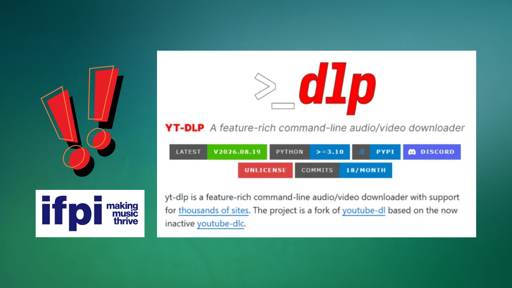
I mean technically speaking unless you have permission of the copyright owner to download their video any tool you use to download (almost) any YouTube video would be a piracy tool.
Your web browser necessarily has to download a YouTube video in order to display it to you. It just doesn’t provide an easy way for that data to be more than ephemeral.
Going to YouTube and having your browser download the video so you can watch it would be an approved way to download the video, making further copies of it more than likely not.
YT-DLP doesn’t make further copies. It downloads a video file from YouTube the exact same way your browser does.
Nnnnnnope. Time shifting.
Time shifting?
https://en.wikipedia.org/wiki/Time_shifting
It’s why DVRing is legal. This tool is no different functionally than a screen recorder pointed at the video. That’s how they used to work, but that changed once TV went digital (they don’t reencode, they store the pre-compressed segments.
Ok that’s fun I was unaware of this term. It’s kind of interesting though to apply the term to something like digital streaming media that’s already, for lack of a better term, pre time-shifted.
Interesting idea. If i subscribe to a streaming service for one month, i can save 31 days * 24 hours of content for later viewing. That would keep ke going quite a while since i only have the time to watch tv for a couple of hours per night…